
Business Litigation Attorney in Pennsylvania
What We Do?
Recent Posts
Contact Us
Strategic, Values-Driven Representation for Complex Commercial Disputes
When business disputes escalate, you need more than aggressive advocacy. You need counsel who understands the strategic realities of Pennsylvania business courts, the speed of federal litigation in EDPA, and the nuanced interplay between Pennsylvania and Delaware corporate law. At Equal Justice Solutions, our Pennsylvania Business Litigation Lawyers represent entrepreneurs, investors, minority shareholders, and companies in high-stakes business litigation throughout Pennsylvania, Delaware, New Jersey, New York, and federal courts nationwide.
Our approach blends sophisticated commercial litigation strategy with transparency, integrity, and a commitment to justice. Whether your matter involves a partner dispute, breach of fiduciary duty, commercial fraud, or a multi-jurisdiction corporate conflict, we focus on delivering clarity, early leverage, and results.
Why Pennsylvania Is a Strategic Forum for Business Litigation
EDPA: One of the Fastest Federal Courts in the Country
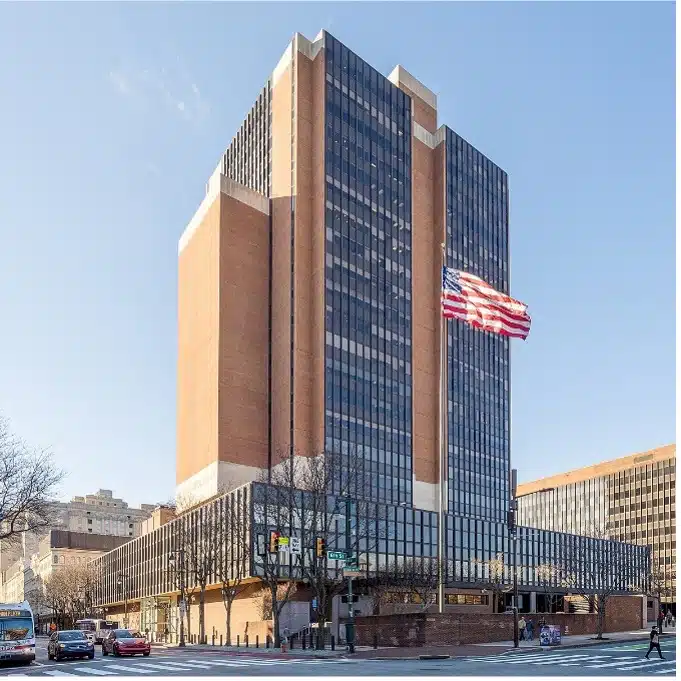
The Eastern District of Pennsylvania (EDPA) is widely known for its efficiency. While published statistics show a median filing-to-trial timeline of approximately 23 months, most civil cases resolve far sooner.
Practitioner experience and court data indicate:
Average civil matters resolve within 4–5 months of filing
This accelerated pace is driven by:
- Early scheduling orders, typically within 60–90 days
- Routine referrals to magistrate judges for mediation
- A robust ADR culture
- A “free day of mediation” for all civil cases
- Active judicial case management
EDPA allows well-prepared litigants to create early momentum, gain leverage, and often resolve disputes before discovery costs escalate.
Philadelphia Commerce Court: Pennsylvania’s Dedicated Business Court

On the state side, Philadelphia’s Commerce Court provides a specialized forum for business-to-business disputes and corporate litigation. Cases qualify for the Commerce Court only if they fall within the program criteria, including:
- Corporate governance and fiduciary duty disputes
- Shareholder, derivative, and partnership conflicts
- Contract disputes, UCC matters, and commercial real estate litigation
- Trade secret and non-compete litigation
- Business torts and unfair competition
- Securities, IP, and complex commercial matters
- Business-related class actions
- Commercial insurance coverage disputes
Cases are placed on one of three tracks:
- Expedited: approx. 12 months to trial
- Standard: approx. 18 months
- Complex: approx. 24 months
Judges work closely with Judges Pro Tempore (JPTs), experienced practitioners who help mediate settlements early in the case.
Commerce Court provides predictability, expertise, and structure, key advantages in complex business litigation.
Cases assigned to Commerce Court are placed on one of three tailored tracks: Expedited (≈12 months to trial), Standard (≈18 months), or Complex (≈24 months). Judges also rely on Judges Pro Tempore (JPTs)—experienced practitioners who volunteer to mediate settlements—helping move cases toward early resolution. Below is a chart that shows key deadlines in the case from date of filing:
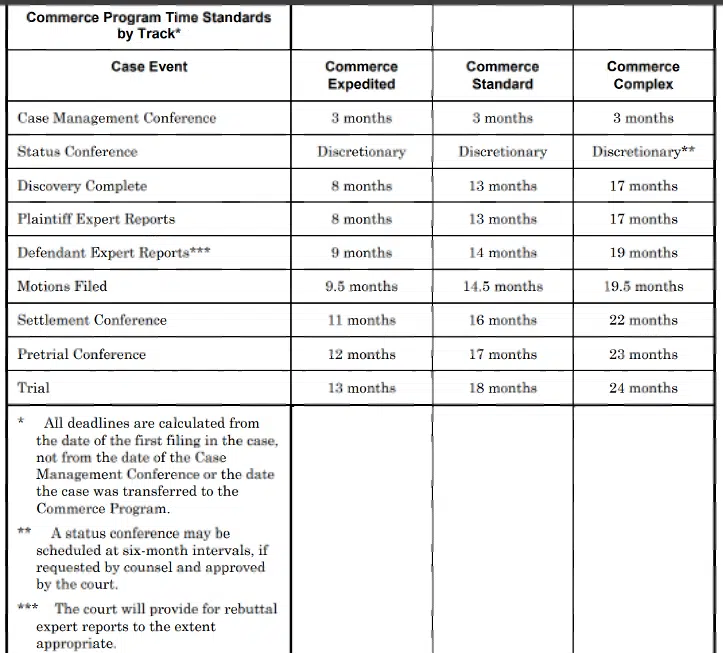
Takeaway: If your case belongs in Commerce Court, you benefit from specialized judges, predictable scheduling, and a forum designed for sophisticated commercial disputes.
Allegheny County’s Commerce & Complex Litigation Center
Western Pennsylvania businesses benefit from an analogous program, the Commerce and Complex Litigation Center in Allegheny County. Cases involving high dollar amounts, multiple parties, corporate governance disputes, and legally intensive matters are assigned here.
The Court employs rigorous case management similar to Philadelphia’s Commerce Court, making Pennsylvania one of the few states to offer two dedicated commercial litigation systems.
Whether your dispute arises in eastern or western Pennsylvania, specialized courts are available to handle sophisticated business matters efficiently and fairly.
How Mallory v. Norfolk Southern Transformed Cross-Border Litigation in Pennsylvania
In Mallory v. Norfolk Southern (2023), the U.S. Supreme Court upheld Pennsylvania’s consent-by-registration statute, creating a new pathway for jurisdiction over foreign corporations registered to do business in Pennsylvania.
PA may be a viable forum for international and out-of-state disputes when defendants have registered to do business here.
Defenses such as arbitration clauses, forum-selection clauses, and dormant Commerce Clause arguments may still apply, but Mallory significantly strengthens plaintiffs’ jurisdictional leverage.
Venue Strategy in Pennsylvania: A Powerful Litigation Lever

Under Pa. R.C.P. 2179, corporate defendants may be sued in any county where they:
- Maintain a registered office or principal place of business
- Regularly conduct business
- Caused the events giving rise to the dispute
- Own property related to the dispute (in equitable matters)
The phrase “regularly conducts business” can be decisive.
A DelCo law firm argued venue belonged solely in Delaware County because 95–98% of its work occurred there. The plaintiff established that 3–5% of the firm’s cases were filed in Philadelphia.
The Superior Court held that 3 to 5% was enough to constitute “regular business,” allowing the case to proceed in Philadelphia, a strategic win that influenced settlement.
Venue selection often determines the leverage, timeline, and ultimate settlement posture of a business dispute. At Equal Justice Solutions, venue analysis is not boilerplate; it is one of the first strategic tools we use
Pennsylvania’s High Pleading Standard: A Challenge and an Opportunity

Pennsylvania is a fact-pleading jurisdiction, unlike the federal courts’ “notice-pleading” standard.
Plaintiffs must allege:
- All material facts with specificity
- Details of fraud with particularity
- Relevant documents or explanations why documents are unavailable
Case Example: Golden Gate National Senior Care
The Pennsylvania Supreme Court reinstated the case only because the complaint contained:
- Specific marketing statements
- Concrete instances of understaffing
- Clear factual links between misrepresentations and harm
General allegations are insufficient.
How We Use This to Strengthen Plaintiff Cases
We leverage unique Pennsylvania tools to build a detailed, compliant complaint before filing:
- Books & Records Requests – 15 Pa.C.S. § 1508
Used to obtain corporate documents and minutes. - Writ of Summons – Pa. R.C.P. 1007(a)
Preserves claims without filing the complaint, buying time to gather facts. - Pre-Complaint Discovery – Pa. R.C.P. 4003.8
Allows limited discovery needed to draft fact-specific pleadings.
Our approach: Build a fact-rich record, then file a bulletproof complaint that withstands objections and creates early settlement pressure.
The 25-30 Hour “Legal Power Pack”
Elite litigation strategy. Complete transparency. Zero risk.
$695/hour – 100% refundable if you are not satisfied.
Most firms demand large retainers without clarity.
We offer the opposite.
You fund 15–25 hours of work (held in a client trust account).
Within 21 business days, we deliver a comprehensive strategic memo including:
- Custom litigation roadmap
- Risk analysis and factual assessment
- Cost projections and timelines
- Venue and jurisdiction evaluation
- Regulatory and reputational risk considerations
- Fee-structure options, including contingency possibilities
If our assessment does not meet your expectations, you fire us, and you owe nothing.
Our rate is a fraction of the Delaware Chancery rates deemed reasonable above $900/hour (see Fortis Advisors v. Johnson & Johnson, 2024), yet includes Delaware representation.
Types of Business Litigation We Handle
- Breach of contract (UCC and common law; enforceable promises under 33 P.S. § 6)
- Breach of fiduciary duty (directors, officers, partners, advisors)
- Shareholder oppression and minority rights (15 Pa.C.S. § 1981)
- Freeze-outs, self-dealing, and corporate mismanagement
- Complex, multi-jurisdictional and cross-border disputes
- Trade secret theft and restrictive covenant enforcement
- Business torts: fraud, conspiracy, unfair competition, interference
- Securities and investor disputes
- Insurance coverage litigation for businesses
- Claims involving accountants, attorneys, and financial advisors
We represent clients in state and federal trial courts, arbitration (AAA and JAMS), and the Delaware Chancery Court.
Small Business Legal Support Program
Access to elite legal advocacy at up to 50% reduced rates
We reserve a portion of our docket for mission-aligned enterprises, including:
- Businesses under $7.5M annual revenue
- Nonprofits and public benefit organizations
- Companies without institutional investors
- Matters demonstrating community impact or financial hardship
A Faith-Driven, Public Benefit Law Firm
Equal Justice Solutions is built on a mission to:
- Do justice
- Love mercy
- Walk humbly
We serve clients of all backgrounds and beliefs, grounded in integrity, accountability, and advocacy for the vulnerable. Every paid matter helps support our pro bono programs.
Who We Represent
- Minority shareholders seeking books and records or asserting derivative rights
- Start-ups and founders harmed by partner misconduct
- Investors facing misappropriation, fraud, or fiduciary breaches
- Companies involved in contract, vendor, or trade secret disputes
- Businesses suing major insurers for wrongful denials
- Organizations evaluating claims against professionals or advisors
Frequently Asked Questions
How long will my case take?
- EDPA: Many cases resolve in 4–5 months; trials occur in 13–24 months.
- Commerce Court: Timelines depend on track, 12, 18, or 24 months.
What remedies are available in breach of contract cases?
Compensatory damages, restitution, specific performance, and in some cases, attorney’s fees. Under 33 P.S. § 6, written promises may be enforceable even without traditional consideration.
What rights do minority shareholders have?
Inspection rights under 15 Pa.C.S. § 1508 and robust remedies for oppression under 15 Pa.C.S. § 1981, including dissolution, buyouts, or appointment of a custodian.
Can you handle Delaware Chancery matters?
Yes. Our Delaware representation is included in our standard hourly rate.
Speak With a Pennsylvania Business Litigation Attorney
Integrity. Strategy. Results.
If you are facing a contract dispute, fiduciary duty claim, or complex commercial conflict, you deserve counsel who will protect your interests with precision and transparency.
Schedule a Confidential Consultation
If you’re looking for a Pennsylvania Commercial Litigation Lawyer—for business litigation, corporate litigation, complex litigation, or a breach of contract or fiduciary duty matter—you deserve counsel that combines precision, transparency, and values.
Ask about our 15–25 Hour Legal Power Pack during your consultation.
- Conshohocken, PA | Wilmington, DE
- 267-388-1852
- info@equaljusticesolutions.org
Equal Justice Solutions Business Litigation with Integrity. Strategy You Can Trust.Standing up for entrepreneurs, partners, and investors—without compromising values.